
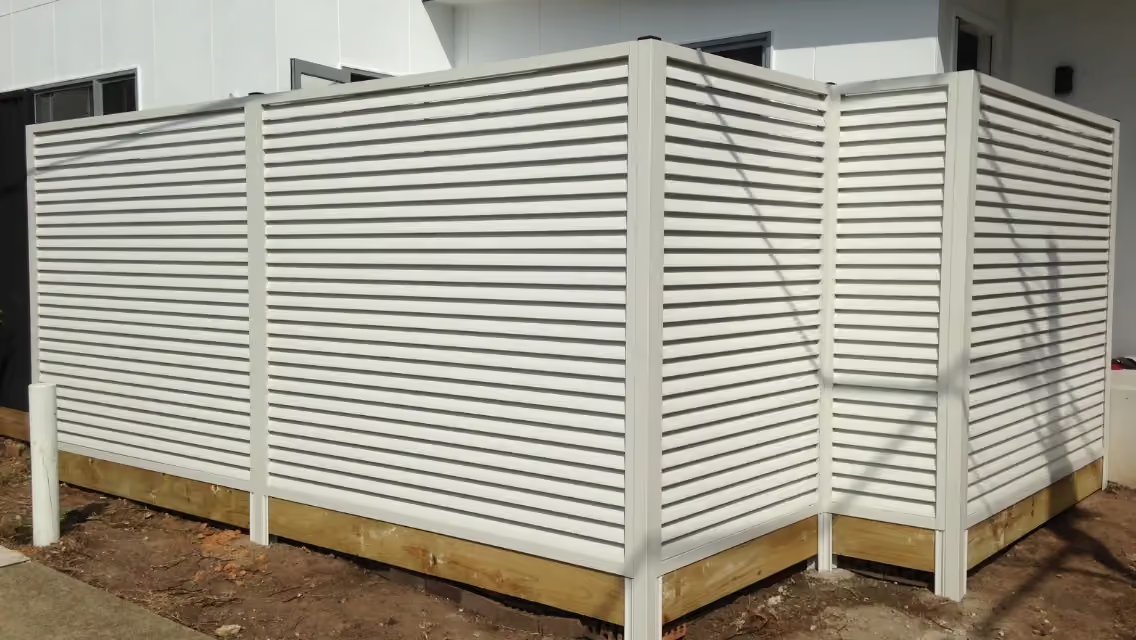
An aluminium privacy screen uses slats to interrupt views into an outdoor area. The privacy you get depends on the gaps, slat depth, orientation and where people look from—not just screen height. Choose the sightline you want to block first, then confirm the layout, supports and access before ordering.
What kind of privacy screen do you mean?
“Privacy slatting” can mean different products. Plastic strips inserted into chain-link mesh are not the same as a framed aluminium slat screen. Aluminium screening uses individual metal slats supported by a frame or channels, with a layout selected for the space.
A privacy screen might shield a patio, break a view along a side path or form an infill panel between suitable supports. Slat fencing follows a fence line; an enclosure screens equipment on several sides. Tell us which problem you want to solve rather than choosing from a product name alone.
For supply and installation in Moreton Bay and North Brisbane, see our aluminium privacy screens and designer fencing service. For equipment screening, start with our enclosure options.
Which slat gap should you choose?
A smaller clear gap leaves less space to see directly through, when the rest of the layout stays the same. It also leaves less open area between the slats. Neither observation tells you the screen’s wind loading, ventilation performance or suitability for a particular site; those need separate assessment.
| Clear gap | What to consider |
|---|---|
| 0 mm | No deliberate gap between slats. Discuss a close-screened layout; do not assume an airtight, weatherproof or acoustic barrier. |
| 5 mm | A narrow opening between slats. Check a sample from the viewing position that matters. |
| 10 mm | A more visible gap than 5 mm with the same slats. Consider both privacy and the appearance you prefer. |
| 20 mm | A more open layout. Check views from the street, nearby windows and your sitting area. |
| 30 mm | The largest gap in this comparison. More of the background is visible straight through than with the smaller gaps, all else equal. |
These are gap choices to discuss, not a guaranteed specification for every screen or enclosure. Confirm the selected slat profile, finished dimensions, product requirements and site suitability in the written quote. There is no single gap that guarantees complete privacy.
Why does the viewing angle change privacy?
Straight-on views can line up with the openings between slats. From an angle, the depth of a slat can interrupt some of those sightlines. A screen that hides a bin from the driveway may still reveal it from a nearby window or when you walk past.
Gap alone does not tell you privacy
Looking square to the screen, lines of sight pass cleanly through every gap.
Same slats, same gaps. From an angle, the side of each slat interrupts the line before it gets through.
How much you can see through a slat screen depends on where you stand and how deep each slat is relative to the gap. Deeper slats block a wider range of angles; straight on, any gap stays see-through. Check the screen from the spots that matter - a neighbour's window, the footpath, your own deck - rather than judging by gap size.
For vertical slats, check views from the left and right as well as straight ahead. For horizontal slats, check views from above and below too. Slat shape, any angle in the profile and the position of the viewer all matter. A photograph of another installation is not a privacy test for your site.
Check the actual view
- Identify the place you want to screen: a seat, window, path or equipment area.
- Photograph it from the street or other accessible viewing points without entering neighbouring property.
- Check standing and seated views, and higher windows where relevant.
- Use a physical sample or mock-up where privacy is critical.
- Check the view after dark if privacy near an illuminated room matters.
Horizontal or vertical slats: which layout suits your space?
Choose the orientation around the views you need to interrupt, the look of the house and the available supports. Neither horizontal nor vertical slats are automatically more private. A useful comparison holds the slat profile and gap constant and changes the viewing direction.
| Your goal | What to check before choosing |
|---|---|
| Screen a sitting area | Views towards seats, the height difference between properties and whether the screen blocks a useful outlook. |
| Screen a side path | Visibility along and across the path, clear walking width, meters, taps and maintenance access. |
| Add screening above a fence | The condition and capacity of the existing fence and supports, added height, neighbour agreement and applicable approvals. |
| Screen pool or air-conditioning equipment | Manufacturer requirements, ventilation, heat discharge, drainage and service access; ordinary privacy screening is not an equipment design. |
| Add a gate or access opening | The clear opening, swing, latch position, ground slope and what must pass through it. |
Can you attach a privacy screen to an existing fence?
Sometimes, but an existing fence, wall or post should not be assumed capable of carrying new screening. Additional screening changes the area exposed to wind. The fence condition, connections, footings and proposed dimensions need assessment; a decorative panel is not a repair for a weak fence.
Our planning rule is to allow a centre post or mullion where a side is wider than 1800 mm. That is a quoting and layout rule, not an engineering span approval or a substitute for assessing the supports and product requirements.
For a shared fence, discuss the proposal and responsibilities with the adjoining owner before authorising changes. Queensland Government guidance explains that you should not attach something to a dividing fence that could damage it. Read the fence-owner guidance.
Check any applicable building or planning approvals with your council or a building certifier. A neighbour’s agreement does not establish whether approval is required, and a quote does not resolve a boundary dispute. No universal height or approval exemption is assumed in this guide.
Do you need a privacy screen or an equipment enclosure?
For a patio or garden view, a screen may be enough. If you need to hide equipment while retaining maintenance access, an enclosure may suit better. A roof, lid, return side or lockable door changes the design and must suit the equipment—not just the appearance.
Our pool pump enclosure page covers access, ventilation and the limits of slat screening for noise. The completed Zillmere laundry enclosure shows another approach using Colorbond under a landing; it is a different material and application, not proof of how an aluminium privacy screen will perform.
What should you send for a privacy-screen quote?
A useful starting point
- A wide photo and a close-up showing the proposed location and existing supports.
- Your suburb and postcode, approximate width and height, and any slope.
- The view you want to block, including whether it is from above or the side.
- Your preferred horizontal or vertical look, gap and colour, if known.
- Any access opening, gate, equipment, services or shared-boundary constraints.
- Whether you want installation or a made-to-measure kit.
Not ready to measure? Start with photos and “not sure” for the dimensions. We will confirm what else is needed before a final quote. There is no approved price list in this guide: the screen, supports, fixing method, access and installation scope determine the quote.
The HandyMan’s TOOLBOX provides local installation across Moreton Bay and North Brisbane, with made-to-measure kit enquiries for Australia-wide delivery. Request a privacy-screen quote or start a kit enquiry. Messages are best while we are working on site.
Questions answered
Are aluminium privacy screens completely private?
Not necessarily. Gaps, slat depth, orientation, screen height and viewing position affect what you can see. Check the specific sightlines and a sample where privacy is important; do not assume a gap size guarantees complete privacy.
What is the best gap between aluminium privacy slats?
There is no single best gap for every job. We discuss 0, 5, 10, 20 and 30 mm gaps, subject to the product and site. Start with the view you need to interrupt, then confirm the profile, supports and finished layout in the quote.
Are horizontal or vertical slats more private?
Neither orientation is automatically more private. For the same slat profile and gap, the viewing direction matters. Check left-to-right sightlines for vertical slats and views from above and below for horizontal slats.
Do aluminium privacy screens reduce noise?
Slat screens interrupt views but are not acoustic enclosures and do not soundproof equipment. If noise is the main problem, ask an appropriate specialist about the source and a suitable acoustic solution.
Can I put privacy slats into a chain-link fence?
Chain-link privacy inserts are a different product from framed aluminium slat screening. This guide covers aluminium screens, not plastic mesh inserts. Do not assume an existing chain-link fence can support a new aluminium panel.
Do you install aluminium privacy screens in North Brisbane?
We discuss made-to-measure screening and local installation across North Brisbane and Moreton Bay, subject to the job and site. Send your suburb, photos and rough dimensions so we can confirm scope and availability.
Sources
Research checked 14 November 2026. External sites may change.
- Queensland Government: your responsibility as a fence ownerShared-fence responsibilities and avoiding damage. Not a product specification or site-specific approval assessment.
General information only; not legal, engineering or compliance advice.
Keep reading
What needs doing?
Often on site and unable to answer calls. Use the quote form, Text us or email your details and photos. Include your name and suburb so we can match them to your enquiry. We will reply when available.