
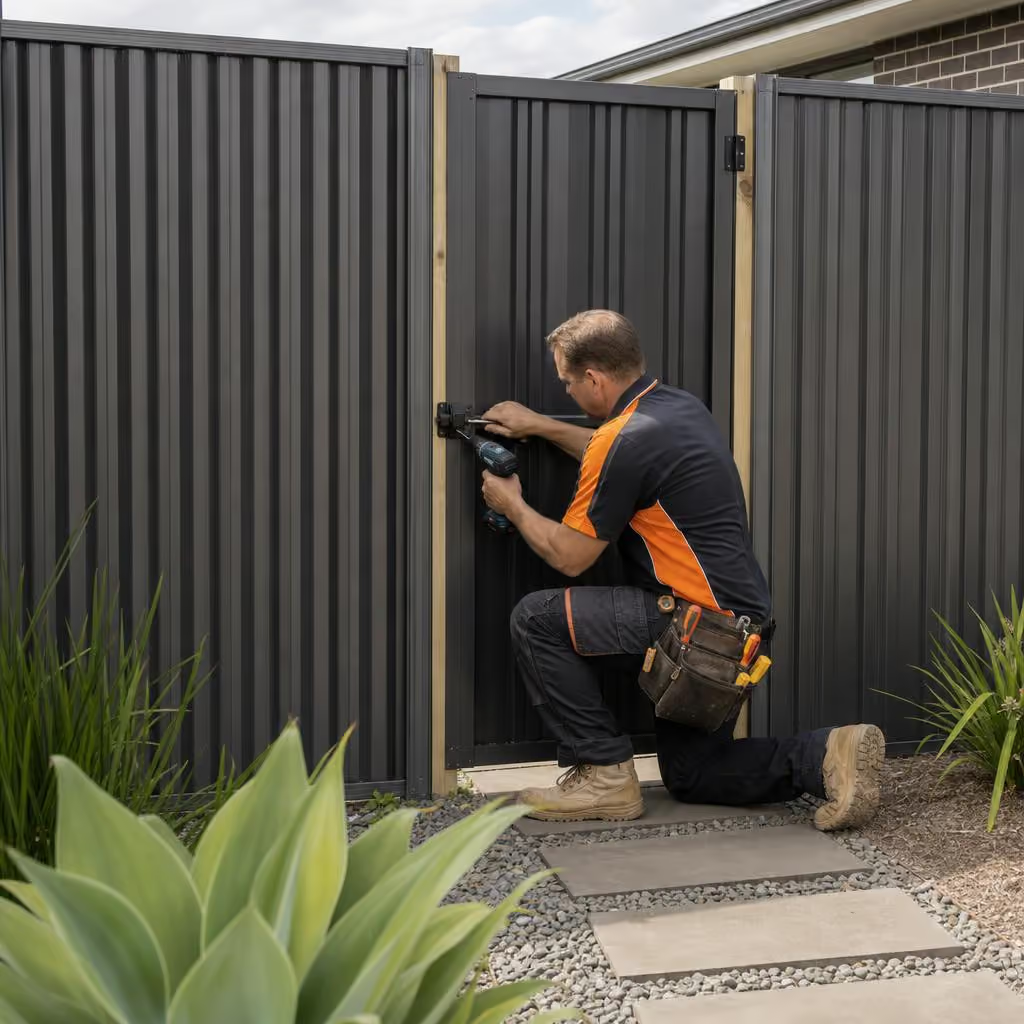
Repair when the fault is in hardware or a single component, such as a hinge, latch or loose screw. Consider replacement when posts lean, rails or bases are rotted, or several panels are failing. Before any boundary work, confirm who owns and uses the fence and whether your neighbour needs to agree. Pool barriers, retaining walls, structural work and gates with electrical automation need specialist assessment.
Diagnose first: hardware problem or structural problem?
Start by separating a hardware fault from a wider support problem. An isolated latch or hinge fault may need a smaller repair than a failing post, but a dragging gate can have either cause. Structural faults sit in the posts, rails and base of the fence and affect how the whole run behaves. Check the supports before assuming replacement hardware will solve the problem.
Signs that point to hardware
- The gate used to close and gradually stopped
- Screws turn without gripping but the timber around them is solid
- The latch or catch is bent, loose or rusted
- The problem is limited to one gate or one panel
Signs that point to structure
- A post leans or moves at ground level
- Timber is soft, crumbling or hollow near the base
- Several panels are loose, bowed or sagging
- Rails have split where they meet the posts
Joyner is a residential suburb on Lake Samsonvale, but proximity to water does not tell us whether your fence has suffered. Judge the fence in front of you. Our Joyner service page explains how we travel to the suburb.
Safe visual checks you can do yourself
Check from a safe distance
- Look along the fence line from one end to spot leaning posts or waves
- Photograph the base of each post and any soft or discoloured timber
- Note gaps at the gate that have changed since last season
- Watch the gate swing, without forcing it
- Keep children and pets clear of any section that moves
Do not push, shake or climb an unstable fence to test it. A fence that is about to fall can injure you or a neighbour. Photograph it, keep clear and ask for an assessment.
Repair or replace: a decision table
| Condition | Likely direction | Why |
|---|---|---|
| Loose hinge or latch, solid timber | Repair | The structure is sound and hardware can be re-fixed or replaced. |
| One cracked paling or panel | Repair | Isolated damage rarely justifies replacing the run. |
| Leaning post, otherwise sound fence | Assess | The cause matters: footing movement, impact or rot. |
| Rotted base on multiple posts | Replace the affected section | Repairs rarely hold when the support is failing. |
| Many panels failing at once | Replace | Piecemeal repairs can cost more than doing the run properly. |
| Gate frame twisted or cracked | Replace the gate | A distorted frame will not hold hardware reliably. |
Treat the table as a starting point. A site assessment can change the answer, and sometimes the cheapest sensible option is a repair now and replacement planned for later.
Boundaries, neighbours and responsibility
The Queensland Government distinguishes dividing fences from retaining walls and pool barriers. For dividing fences, adjoining owners generally share the cost of a sufficient fence, but there are exceptions, and questions such as who damaged it and what notice or agreement is required all matter. This guide does not tell you that you automatically owe or are owed half of any cost.
- Establish whether the fence sits on a boundary or entirely on one property
- Talk to your neighbour early and, where appropriate, put agreements in writing
- Do not authorise boundary work until the people with authority have agreed
- Read the government guidance for your situation or seek advice for disputes
Work that needs a specialist assessment
The Queensland Building and Construction Commission (QBCC) notes that licensing requirements for fence builders depend on the scope and material of the work. We avoid simple dollar thresholds because they can mislead. When in doubt, ask for the scope to be checked.
- Pool barriers and anything protecting a pool
- Retaining walls and fences that carry earth load
- Structural changes or large replacement runs
- Automated gates with electrical wiring or motors
How to compare fence and gate quotes
| Item | Ask |
|---|---|
| Scope | Which posts, rails, panels and gates are included? |
| Materials | Type, thickness and finish for each part |
| Removal and disposal | Is old material taken away and is that priced? |
| Finish | Paint, stain or none, and who supplies it? |
| Access | Any extra for slopes, tight sites or long carries? |
| Approvals | Who confirms boundary authority and neighbour agreement? |
A low price that leaves out disposal or finishing is not necessarily lower. Ask each provider to write the same list so you can compare like with like. Our Warner home improvement checklist helps you prepare a clear scope.
Questions answered
Do I have to pay half for a neighbour's fence?
Not automatically. Responsibility depends on the circumstances. Check the Queensland Government guidance and seek advice if needed.
Can a handyman replace a whole fence?
It depends on scope and materials. Licensing requirements vary, so confirm the scope before work is arranged.
Is a leaning post always urgent?
Not always, but it should be assessed. Keep clear of unstable sections.
Can you quote from photos?
Often for hardware repairs. Larger jobs may need an in-person assessment.
Sources
Research checked 16 October 2026. External sites may change.
- Queensland Government: your responsibility as a fence ownerDividing fences, retaining walls and pool barriers.
- QBCC: licensing requirements for fence buildersLicensing depends on scope and material.
- Moreton Daily: JoynerSuburb context.
Images on this page are illustrative service photos, not evidence of local completed projects. General information only; not legal, engineering or compliance advice.
Keep reading
What needs doing in Joyner?
Often on site and unable to answer calls. Use the quote form, Text us or email your details and photos. Include your name and suburb so we can match them to your enquiry. We will reply when available.