
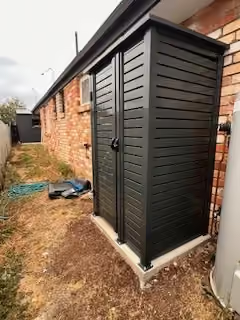
Before designing an equipment enclosure, identify the equipment and obtain its required clearances, airflow and servicing access from the manufacturer and appropriate qualified installer. Then plan the supports, slats and doors around those requirements. A decorative screen must not compromise operation or emergency access.
Identify exactly what is being screened
A pump, hot-water unit and battery are different installations. Even equipment in the same category can have different instructions. Record the make and model, find the installation information and ask the qualified installer to confirm requirements before dimensions or slat gaps are agreed.
Do not guess that an enclosure is suitable because another property has something similar. Photos can show appearance, but they rarely establish clearances, airflow or compliance. A proposed enclosure may need to change substantially—or may not be appropriate—once those requirements are known.
Plan for maintenance and replacement
Access questions
- Can controls, valves, labels and isolation points remain accessible?
- Where does the technician stand and use tools?
- Can doors open fully without blocking a path?
- Can equipment be removed without dismantling unrelated services?
- Are emergency access and any required clear zones maintained?
- Do meter readers or other authorised people need access?
- Will the ground remain safe and accessible after rain?
A small access door may be enough for a glance but not enough for maintenance. Think about the largest item that may eventually need removal. Door hinges, catches and opening direction should be considered with the surrounding path, fence and wall rather than decided after the frame is built.
Do not use one ventilation rule for everything
There is no single slat spacing or enclosure depth recommended by this guide. Ventilation and separation requirements belong to the particular equipment, its installation and any relevant regulations. A design can look open while still obstructing an inlet, outlet or required clearance zone.
Supports and fixings also need planning. Hidden pipes and cables can make an apparently convenient post position unsuitable. Do not drill, move equipment or close off a service area while requirements remain uncertain.
Who confirms the equipment requirements?
| Information | Where to confirm it |
|---|---|
| Equipment model and instructions | The equipment label, manufacturer and installation documentation. |
| Ventilation, separation and service access | The manufacturer and appropriate qualified installer for that equipment. |
| Screening layout and finish | Discuss the enclosure with us after those equipment requirements are known. |
| Equipment modifications or certification | The appropriate qualified provider; these are not included in our screening scope. |
For batteries, the Queensland Electrical Safety Office says a licensed electrician must install the system and commission it in accordance with manufacturer instructions and relevant standards. It also explains that battery technologies have different installation, operation and maintenance requirements. This is why a generic screening drawing cannot establish suitability.
What information helps with an enclosure enquiry?
- Photos of the whole area, access path and equipment labels.
- Approximate width, depth and height available.
- Manufacturer instructions and installer advice.
- Door locations and access preferences.
- Colour and slat-style references.
- Any known service routes or fixing restrictions.
See our custom aluminium enclosure service for scope and sample drawings. The project photo sequence illustrates a particular enclosure, not a universal template. The quote should describe screening, supports, hardware and finish without implying equipment alterations are included.
Turn the idea into a clear enquiry
Include your suburb, approximate dimensions, the result you want and any timing constraints in the quote form. Email supporting photos separately to quote@handymantoolbox.com.au, using the same name and suburb. An initial discussion helps identify what needs a site visit, a product decision or specialist advice before a scope can be confirmed.
We travel across Brisbane northside and Moreton Bay, including Warner, Joyner, North Lakes and the Redcliffe Peninsula. A guide is a starting point, not an installation specification, engineering opinion or guarantee that a particular design suits your property.
Questions answered
Will an enclosure make equipment quieter?
No soundproofing result is promised. Acoustic treatment and equipment operating requirements need their own assessment.
Can I use the drawing as an installation plan?
No. It is an indicative design example, not a certified plan or a substitute for equipment instructions and site assessment.
How much ventilation does an equipment enclosure need?
This guide does not specify a universal gap or vent size. Confirm the actual equipment model, manufacturer instructions and qualified-installer requirements before setting the design.
Can an enclosure be installed without moving the equipment?
That depends on the site, safe fixing locations and required access. Screening does not include relocating equipment or altering pipework, gas connections or electrical services.
What photos should I send?
Send a wide view of the equipment area and access path, plus equipment labels and any existing installation instructions. Add your suburb and rough measurements. Photos support an enquiry but do not replace a site or safety assessment.
Sources
Research checked 25 October 2026. External sites may change.
- Queensland Electrical Safety Office: battery energy storage systemsOfficial installation and safety guidance; equipment-specific advice is still needed.
General information only; not legal, engineering or compliance advice.
Keep reading
What needs doing?
Often on site and unable to answer calls. Use the quote form, Text us or email your details and photos. Include your name and suburb so we can match them to your enquiry. We will reply when available.